
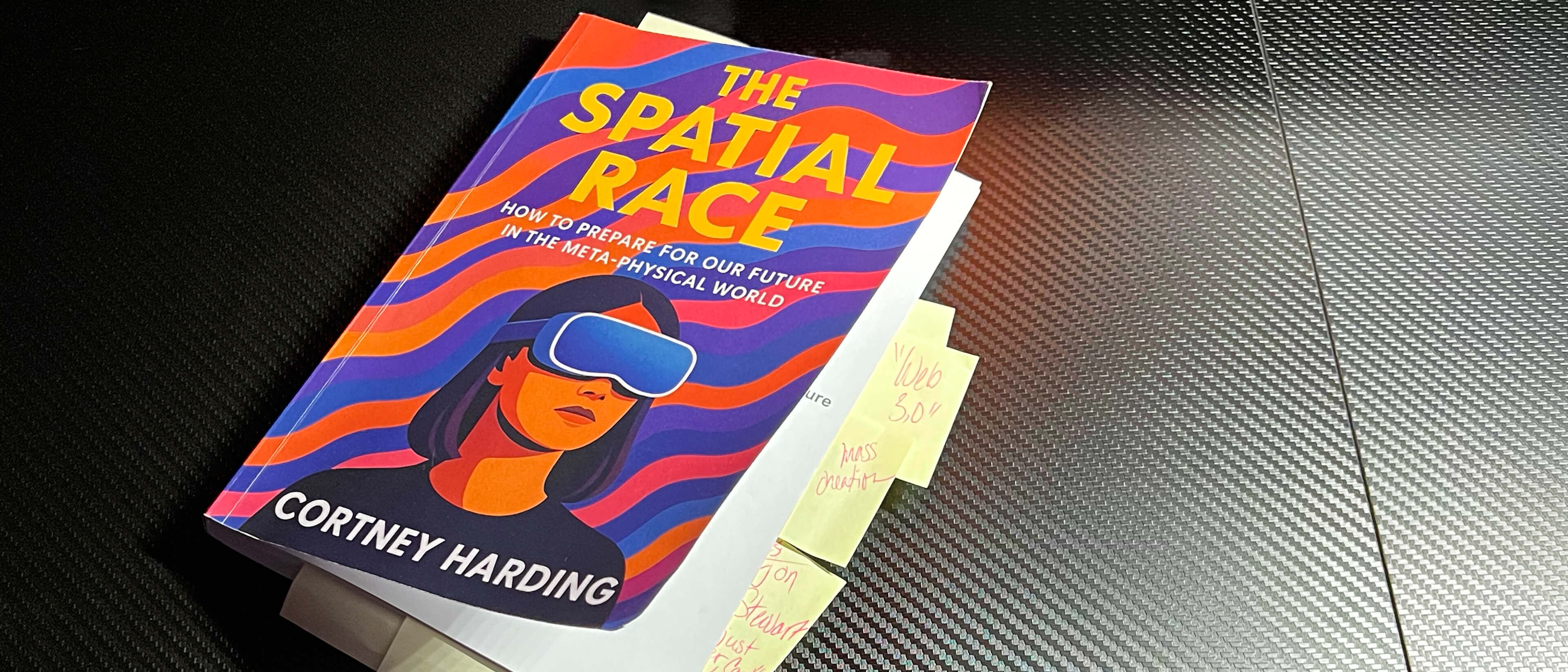
I am still processing Cortney Harding’s “little” 200-page book. I have so many questions!
Are we really just now entering “Web 3.0”? Seems like web 2.0 should have expired a long time ago.
What exactly do we mean when we speak abut AI? Do we mean generative AI, and is that the same thing as LLMs?
XR seems to have faltered these past few years, so how will it be different the future?
Choosing optimism, with responsibility
Call it confirmation bias, but in this sea of questions I immediately latched onto a couple of Cortney’s ideas that are more familiar to me. Coming at this from a Creative Director’s point of view, I want to talk about novel opportunities we humans have, to enhance our technological experience. I’ll go back to those larger questions as I re-read certain parts of the book.
I’ve been reading people’s thoughts, triumphs and rants about AI (mostly in LinkedIn). I notice a trend in which users feel threatened, in a “humans vs. AI” mentality. As if it were born of a separate evil mother from another universe, and not our own invention. I deeply believe we humans have the power to decide, and follow through with, creating whatever we think AI should be.
Much has been written about the content Al currently produces being ‘slop,’ and those critiques do have some merit. But when you pull back and look at the scope of culture produced by humans, the truth is that most of it is slop as well.
Bad content is not exclusive to AI. Humans have been creating boring, misleading, poorly executed content for centuries.
So the trick is not to stop AI (as if you could)! It is to collectively choose to use it for good. And as I look back over the years of bad content created in movies, TV, and the internet of the past — including chat rooms that literally threaten the safety of children — the problem of detecting and restricting bad content is not new. Having said that, I do understand, this challenge is about to scale up big time.
Does XR carry the same threat? I don’t think it’s as ubiquitous as AI promises to be. Cortney warns us of some of the possible dangers of over-using headsets. But with XR, and as we are about to see with AI, perhaps the biggest failure we may encounter in “web 3.0” is mediocrity. Failure to recognize and exercise the full potential of novel tools and new media is the threat that scares me personally.
We should resist the desire to rebuild what we have now in Web 3.0 This is one of the biggest problems in virtual reality. People take 2D concepts and port them into virtual worlds, without stopping to think about whether they will translate and what the true possibilities are.
Around 2016 I viewed all the VR content I could get my hands on. There were a few great productions that allowed me to experience sensations I never could have felt in any other medium. Truly spatial three-dimensionality. Disarming empathy. Curiosity raised to new heights — and summarily satisfied. Most of it was pretty cool. Much of it was ineffective, and didn’t bring anything new to the table except apparently higher production costs.
The same thing happened during Web 1.0, when companies put their offerings online and called it a day. Someone could read the newspaper or a magazine online, but it was functionally the same as reading the print version.
I am old enough to remember when the World Wide Web first became accessible to the masses. Do-it-yourselfers relied on the technology not only to publish, but to design by default without much thought or creativity. Designers and storytellers may have taken awhile to develop their style for the new medium, but eventually we collectively raised the expectations of publishers and their audiences.
It can be different. We can design worlds for deep engagement, problem solving, and collaboration. We can use devices in creative ways to connect us and make us more empathetic. We can create things that look, sound, and feel different.
People are already doing it. Amazing things are showcased on LinkedIn, by those who are embracing the tools and allowing imagination and creativity to thrive.
Click the images below to to get a glimpse of the possibilities.

ART

ADVERTISING

VIDEO

HEALTH

REAL ESTATE
What it requires is teaching creativity and empowering people to take risks. VCs need to fund projects and companies built by diverse founders who want to push the boundaries, and ask what will truly bring people together and promote creativity.
Cortney Harding also tirelessly reminds leaders, we need to identify and clarify goals first, set strategy and evaluation benchmarks, and allow for experimentation. This may include failure, but it certainly does not include giving up. Otherwise you end up in “Pilot Purgatory”.
Thank you Cortney, for your optimistic view of our distinctly human ability to develop technology in ways that elevate the human experience, as well as our ability to keep it on a productive track.
Now, before I put the book down, I’m going to wrap my head around the definition of web 3.0, warm up to my virtual twin, and attempt to comprehend the true scope of AI.