

Why are AI, XR and crypto all considered “Web 3.0”?
Why is AI being treated as something entirely new? I’ve been using amazing AI tools in photoshop for at least a decade now. And isn’t my Roborock vacuum cleaner a classic example of AI? What about Siri? Alexa? The lane detection features in my car?
Do I really need a “digital twin”? Why would we replicate our physical world in cyberspace?
Learning about emerging technologies is confusing enough without misnomers, overgeneralizations, and fuzzy semantics. There’s too much hype around AI, XR, blockchain and the metaverse, and it’s really not clear exactly what we are all so excited about. As Cortney Harding points out in her book, The Spatial Race, sometimes “catchall terms” are widely adopted during rapid technological change due to lack of understanding. Coders and scientists know these terms are inaccurate. But it’s hard to hear them over the roar of the masses. So I followed the footnotes on page 35.
Web 3.0: utopian aspirations
According to Gavin Wood, who is credited with coining the phrase, web 3.0 is a decentralized version of the internet that gives users self-sovereign identity and direct control over their data.¹ In web 2.0, we hand our data over to large corporate platforms (like Amazon, Facebook or Google) and subject ourselves to their algorithms and gateways. We trust them to keep our identity and our currency safe. Since Web 3.0 does not require this extension of trust, it’s called “trustless”.
In web 3.0, the services we use will not be hosted by a few huge companies, but rather “purely algorithmic” entities held by many people in open source, auditable segments. Initially, we will give up certain conveniences to work outside the centralized entities. But it allows us to have a “credible expectation” of privacy, security, freedom of speech, direct verification, and a democratic distribution of power.
Blockchain is an underlying technology of web 3.0. In principle, it allows individuals to exercise more power over the platforms supporting the services we use.
Individuals could, in theory, run their own Etherium or blockchain nodes. This requires technical acumen and it’s not a quick and easy thing to set up. So the typical user will end up using centralized services as intermediaries anyway. But the end goal, as the technology matures, is to allow users to access blockchain more directly, with verified and validated data all along the path. “We need these idealistic visions” to stay motivated to keep envisioning and inventing, according to Wood.
Cortney’s vision is perhaps more realistic, and her wider interpretation of “web 3.0” — the sum of convergent technologies — enables us to envision our future with both practical and aspirational expectations.
AI and XR are separate enhancements layered over web 3.0, but we will experience them seamlessly in the future, not only online but also offline in the physical world.
A slice of AI pie
AI will personalize content and offers, automate workflows, and analyze decentralized data. AI provides continuous, intelligent, adaptive capability, enabling context-aware decisions and direct interactions with diminishing friction. Web 3.0 will utilize a stack of complimentary techniques to accomplish these things.
But the current wave is all about Large Language Models. LLMs are just a small subset of Deep Learning, which is a subset of Neural Networks, which are a subset of Machine Learning…again a subset…of AI. Scientists may disagree about the precise nature of relationships between various AI disciplines, but Jay Latta explains, “We’re not witnessing ‘the dawn of AI.’ We’re witnessing the narrowing of it — a regression into linguistic myopia dressed as progress.”²
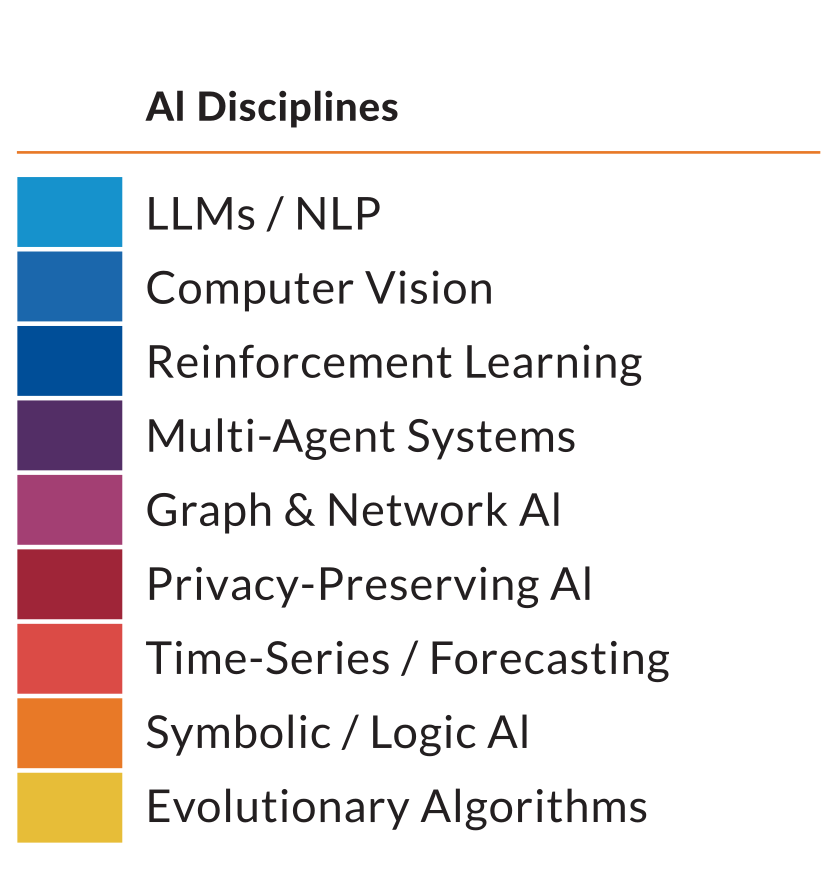
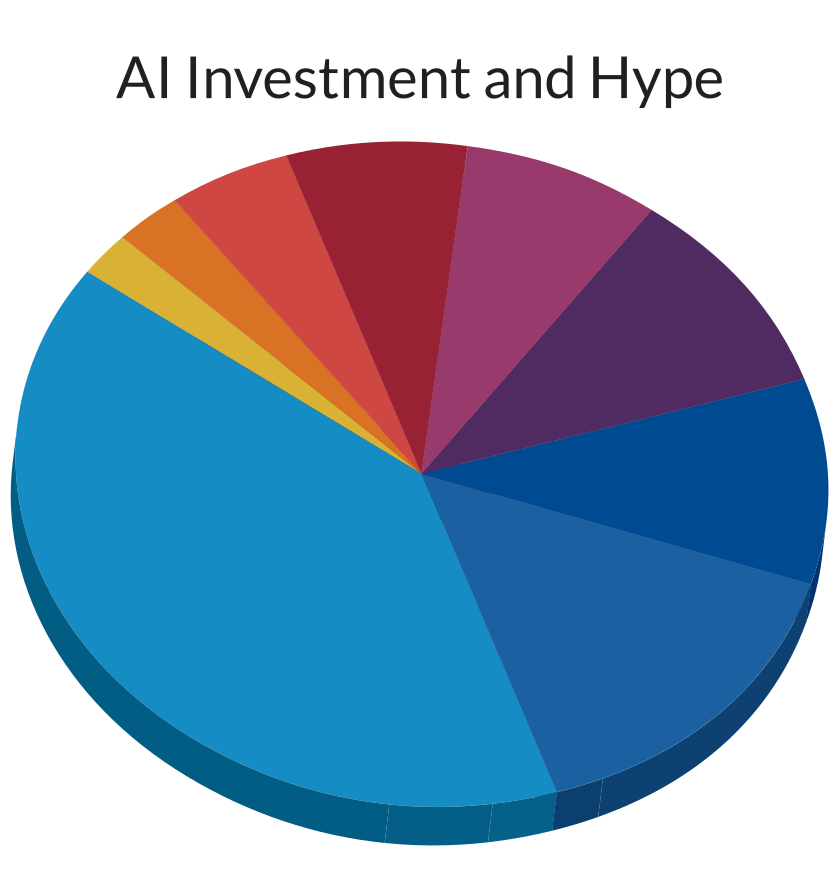

LLMs are an impressive development in the progression of Artificial Intelligence. They’ve made quite a splash in our culture already. They will often wrap around other technologies to make them more accessible to humans, pushing progress towards web 3.0 further. But the term “AI” is a somewhat misleading generalization in the context of the current hype.
So I’m not sure exactly which technologies Cortney thinks of when she says that web 3.0 will be “powered by” AI, but the technology is not entirely new. What’s important to anticipate is that AI will be “running in the background, giving us contextual information all day long.”
Instead of “leaning forward” to click a tool, craft a prompt, or perform a search, we’ll be “leaning back” allowing AI to proactively assist us in our work and other daily activities. We are moving toward a frictionless society in which our needs are anticipated and problems are solved before we even realize we had a problem.
What’s so spatial about the future?
XR (Virtual Reality, Augmented Reality and Extended Reality) will allow us to step away from our computers and look up from our screens. Here’s where the “spatial” part of spatial computing comes in. In the future (starting now) we’ll wear glasses that overlay relevant information onto store displays, museum exhibits, and city streets. If you haven’t had the privilege of trying AR glasses yet, perhaps you’ve driven a car in which your speed and other real-time data appear to be projected in your field of vision somewhere “out there” in front of your windshield. These tools will help us make decisions, learn new information, and navigate throughout the day. On the other hand, we can use headsets to detach from the external world, and escape into immersive simulations, games and experiences. We can virtually “travel” around the world, or retreat into the depths of our imagination. Not just “using” the technology, but “living in” it.
Digital twins and mirrors of reality
When I first read Cortney Harding’s Chapter on the metaverse, I understood my “digital twin” to be my profile with an avatar that represents me in a virtual world. But I’ve seen the term applied to environments as well. These digital twins may be used to test processes virtually, saving time, money and human resources by running scenarios in non-destructive ways. Factories and power plants, for example, can use digital twins to run simulated production processes that reveal potential problems before they power up.
Training programs will allow first responders and high-risk workers to practice tasks in completely safe virtual environments that mirror dangerous situations with stunning accuracy. Trainers and trainees will come together in real time from remote locations around the world. The effectiveness of these kinds of endeavors are well documented by Cortney.
The metaverse includes all this, plus virtual worlds designed for recreation. Social spaces will be created where people may interact with one another, and participate in shared events. Gamers will continue to enjoy increasingly spectacular experiences individually… or in connection with real opponents and communities…with avatars.
What was that question again?
Why are these separate technologies lumped together under one “web 3.0” umbrella? After researching this question pretty diligently, I can’t say I’ve found a very solid reason why. What I do understand, is that futurists like Cortney Harding foresee a world where various forward-moving technologies converge to create a utopian culture in which the internet is decentralized, intelligent, interactive and immersive.
Sounds like fun to me! But I’m just beginning to understand. So please feel free to reach out with questions, corrections and comments.